Transport Infrastructure · War Damage · Preliminary Estimate
Strike on Shostka Railway Station: Environmental Footprint of the Destruction
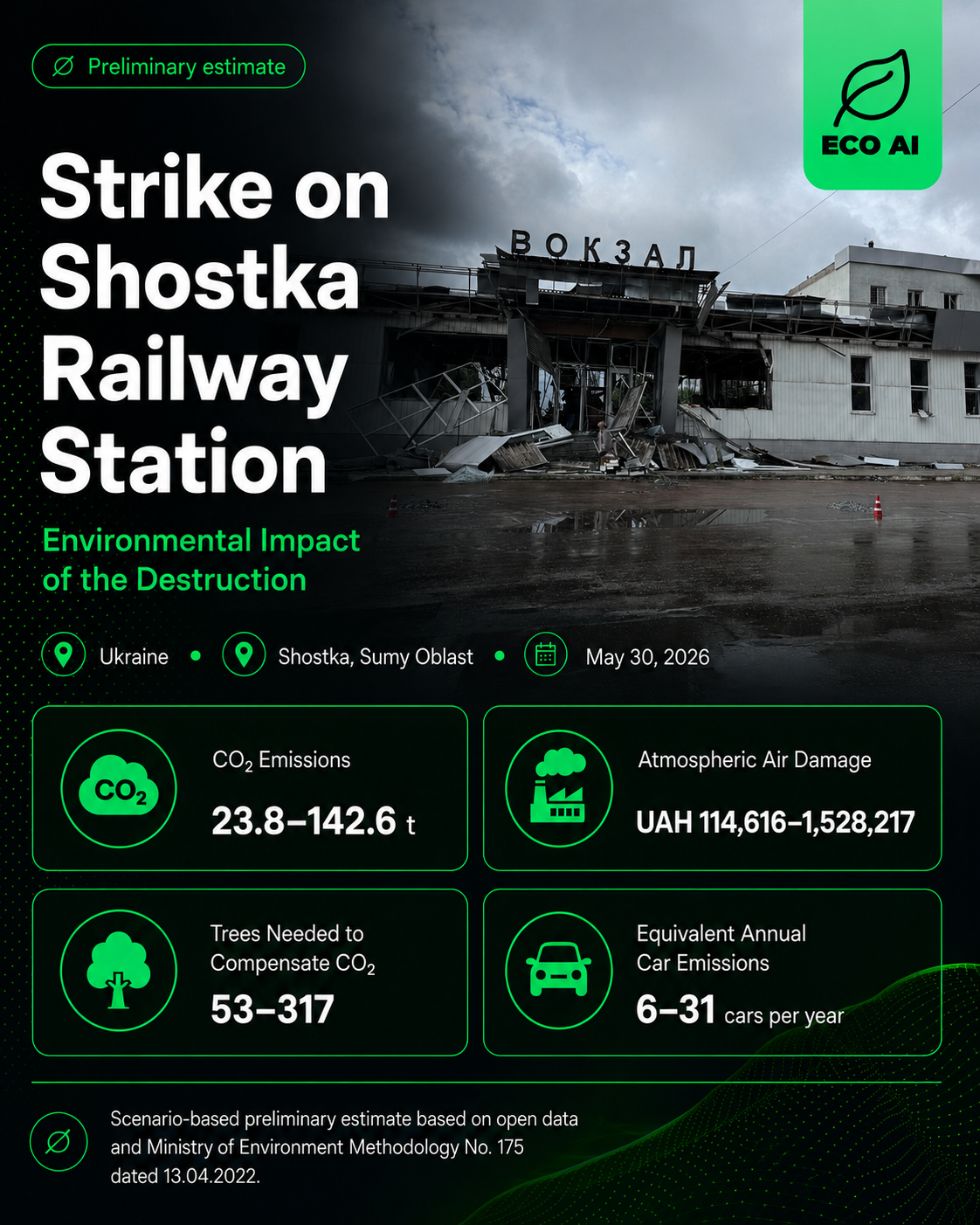
On the night of 30 May 2026, Russian forces carried out a large-scale attack on railway infrastructure in Shostka, Sumy Oblast. Several dozen attack drones struck the station area, completely destroying the railway-station building and damaging tracks, platforms, communications systems and other elements of the railway complex. Station employees and passengers moved to shelters in time, preventing casualties at the station itself.
Ukraine's State Emergency Service confirmed that fires occurred following the attack. Open-source reports and photographs from the site also indicate a major fire around the destroyed station building. Residential and non-residential buildings, administrative premises, vehicles and other civilian infrastructure across Shostka were damaged during the same attack.
The assessment uses an estimated station-complex area of 2,000–7,000 m² and a scenario-based burned area of 300–1,800 m². Official information on the exact fire area and burning duration has not been published, so coefficients for an unknown duration or a fire lasting up to 12 hours were applied. The lower bound represents the minimum burning scenario involving the main station building, while the upper bound reflects an expanded scenario covering the station and adjacent railway infrastructure.
Materials that may have burned include wooden structures, polymer-based finishes, roofing materials, cable insulation, electrical and telecommunications equipment, furniture, fuel and vehicle lubricants. Potential emissions include CO₂, smoke, soot, ash, fine particulate matter and products of incomplete combustion.
The tree estimate relates exclusively to conditional compensation for CO₂ emissions, assuming planting and maintenance for at least 10 years. Trees do not neutralise soot, dust, ash, heavy metals, plastics, fuel and lubricants, or contamination of water and soil.
Browse all preliminary environmental damage assessments published by ECO AI.