Residential Infrastructure · War Damage · Preliminary Estimate
Strike on Residential Buildings in Dnipro: Environmental Impact
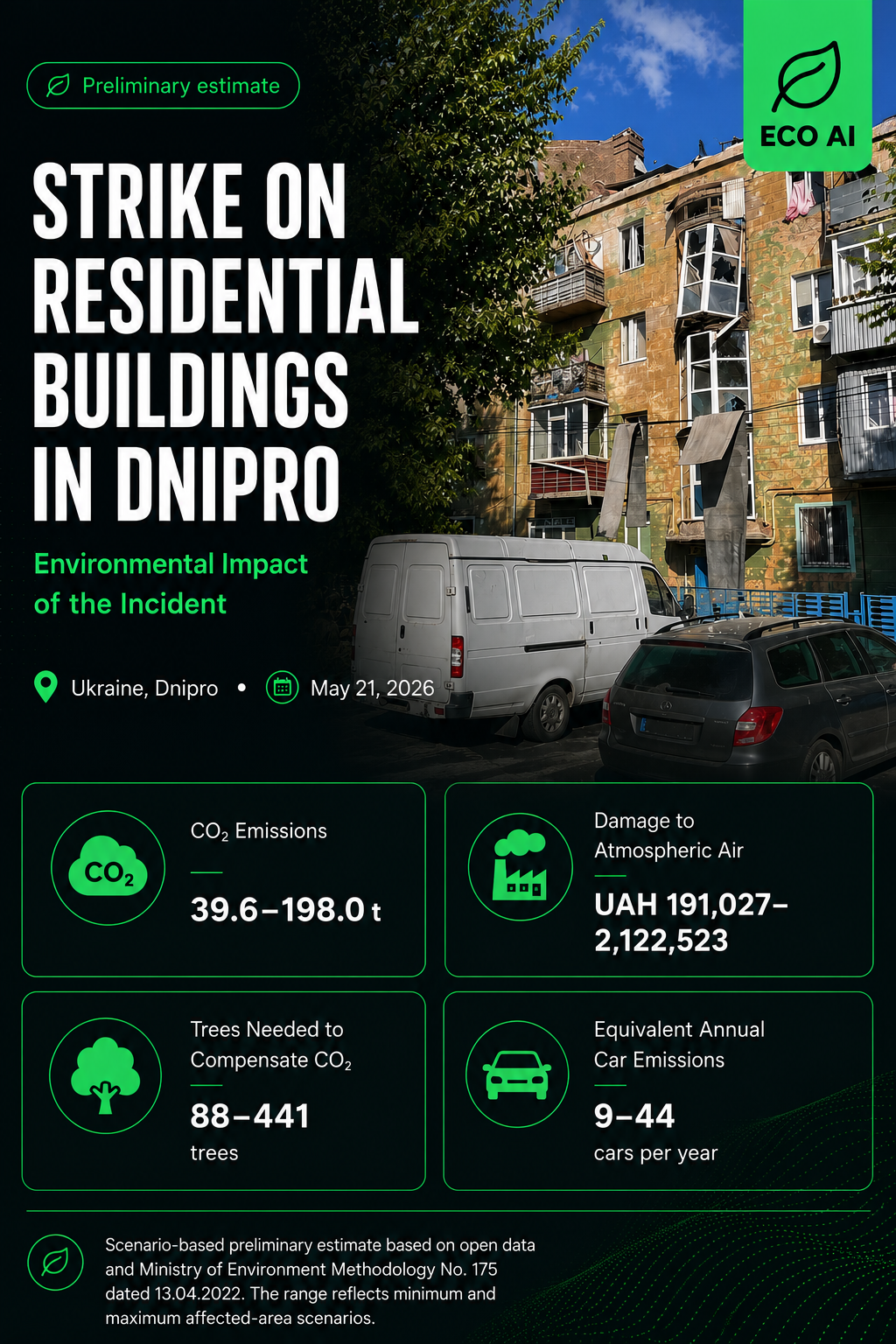
On the evening of 21 May 2026, Russian drones attacked residential areas of Dnipro. Two multi-storey apartment buildings were damaged. The upper floor and part of the roof above two entrances were destroyed in one building, while another sustained a large opening in its façade and damage to several apartments. A fire broke out following the attack. Other buildings, local cafés, vehicles and elements of urban infrastructure were also damaged.
The main environmental footprint is associated with the combustion of building and household materials, the destruction of residential structures and the generation of a substantial volume of debris. Materials that may have burned include wood, furniture, polymer-based interior finishes, thermal insulation, cable insulation, household appliances and roofing components.
Incomplete combustion of these materials can release CO₂, carbon monoxide, soot, volatile organic compounds and fine particulate matter. The destruction of upper floors, façades and roofing also generates construction dust and waste consisting of glass, concrete, brick, metal, plastics and insulation materials.
The scenario assessment uses an estimated total residential-building area of 10,000–30,000 m² and a possible burned area of 500–2,500 m². Open sources provide no precise information about the duration of the fire, so the assessment uses a scenario in which burning lasted up to 12 hours. The lower bound reflects localised burning within part of a residential building; the upper bound represents an expanded fire and damage scenario within the affected residential area.
The tree figure relates exclusively to notional compensation of the CO₂ footprint, assuming planting and maintenance for at least 10 years. Trees do not compensate for soot, toxic combustion products, construction dust, soil or water contamination, or hazardous waste.
Browse all preliminary environmental damage assessments published by ECO AI.