Residential Infrastructure · War Damage · Preliminary Estimate
Strike on a Private House in Bohodukhiv: Environmental Impact
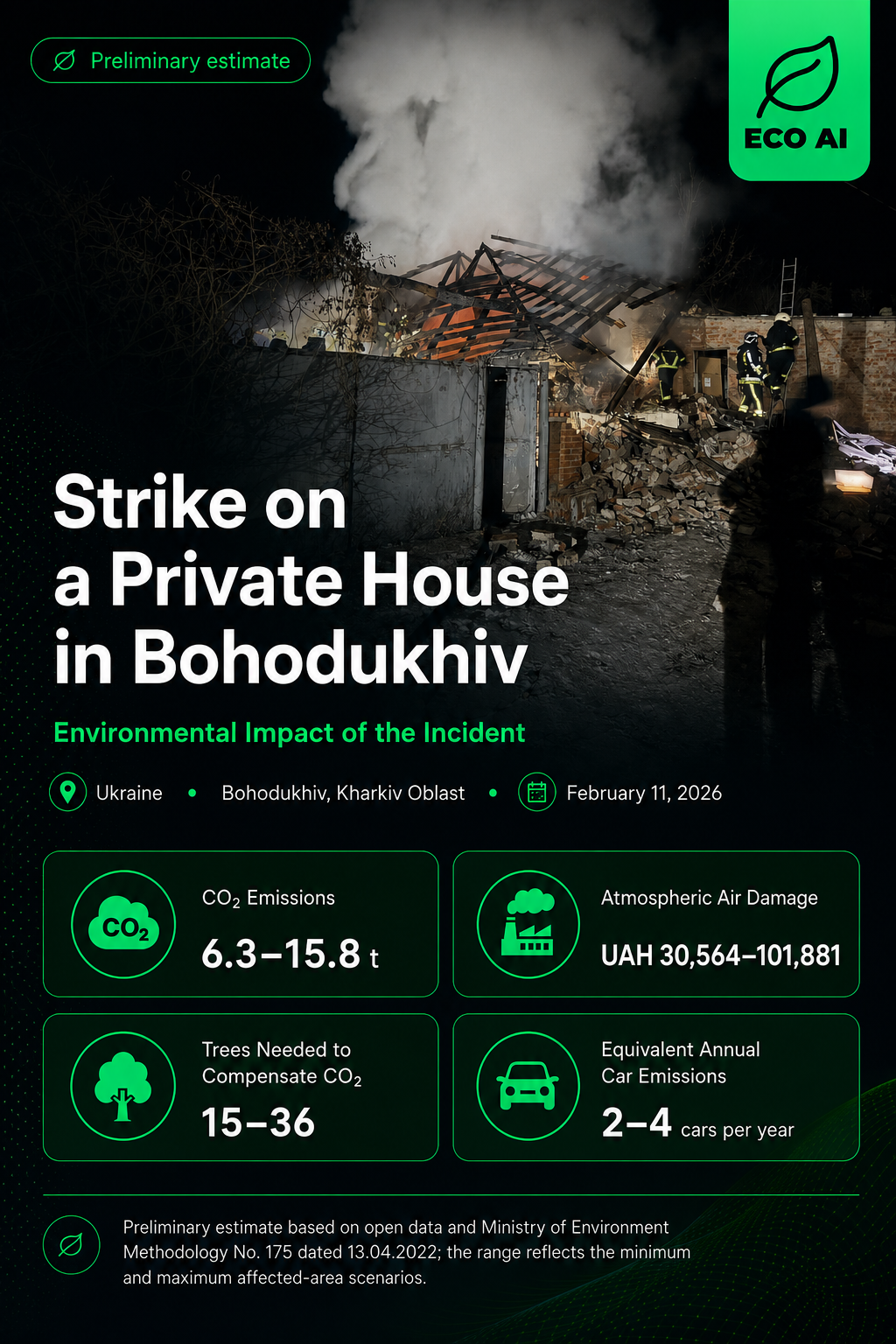
On 11 February 2026, late on 10 February or overnight into 11 February, a Russian drone struck a private house in Bohodukhiv, Kharkiv Oblast. The direct hit destroyed the building and caused a fire. The potentially affected zone also includes nearby residential buildings, vehicles and engineering infrastructure, although its precise boundaries require official geolocation and emergency-service data.
The main environmental footprint is associated with the combustion of building and household materials, as well as the generation of smoke, soot, ash, dust and debris. Materials that may have burned inside the house include wood and furniture, polymer-based interior finishes, cable insulation, household appliances and other interior components.
Incomplete combustion of these materials can produce a mixture of gaseous pollutants and fine particulate matter. Structural destruction also creates construction waste, some of which may require separate sorting and safe handling.
For the scenario assessment, the house area was estimated at 100–250 m², while the possible burned area was estimated at 80–200 m². No official information about the duration of the fire was identified in open sources, so the assessment uses a scenario with an unknown duration or burning lasting up to 12 hours. The lower bound reflects the minimum area and quantity of materials that may have burned; the upper bound represents an expanded scenario within the same property.
The tree figure relates exclusively to notional compensation of the CO₂ footprint, assuming that the trees are planted and maintained for at least 10 years. Trees do not compensate for soot, toxic combustion products, soil or water contamination, construction debris or hazardous waste.
Browse all preliminary environmental damage assessments published by ECO AI.