Residential Infrastructure · War Damage · Preliminary Estimate
Drone Strike on a Nine-Storey Apartment Building in Odesa: Environmental Impact of the Fire
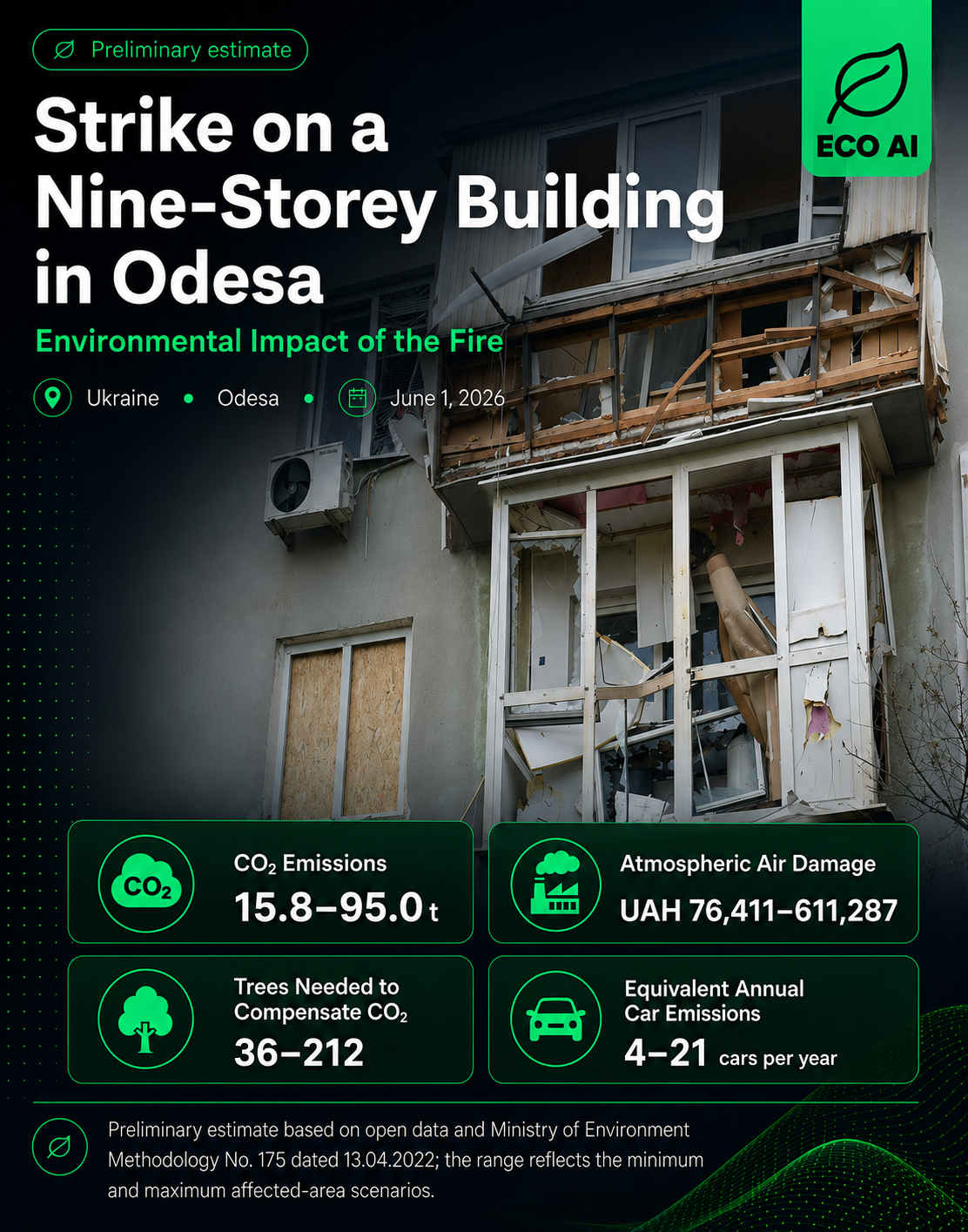
On the night of 31 May–1 June 2026, Russian forces attacked Odesa with strike drones. One drone hit a nine-storey residential building. Published reports indicate that the first and second floors were partially destroyed, while the façade, balconies, and windows were damaged. Police also reported damage to other residential buildings, an administrative facility, warehouses, and vehicles.
A fire broke out in the apartment building after the impact. One resident reported that a gas pipe and a balcony caught fire and that residents attempted to contain the flames before emergency crews arrived. The State Emergency Service confirmed damage to the building's façade and balconies and conducted rescue operations at the site.
The environmental footprint is associated with the combustion of residential and finishing materials, damage to gas and utility infrastructure, and the mechanical destruction of building structures. Potential emissions include CO₂, smoke, soot, ash, fine particulate matter, and products of incomplete combustion.
Materials that may have burned include wooden furniture, textiles, plastics, cable insulation, polymer-based finishes, thermal insulation, household appliances, paints, and coatings. Open sources do not provide the precise composition or mass of the materials consumed.
The ECO AI scenario assessment uses an estimated total building area of 6,000–12,000 m² and a possible fire-affected area of 200–1,200 m². The fire duration is modelled as lasting up to 12 hours. The lower boundary represents localised burning in several apartments and balconies, while the upper boundary reflects possible fire and smoke spread across a larger part of the damaged section.
The tree figure represents only notional compensation for the calculated CO₂ emissions. Trees do not remove soot, construction dust, plastics, technical fluids, contaminated firefighting water, or hazardous demolition waste.
Browse all preliminary environmental damage assessments published by ECO AI.