Transport Infrastructure · War Damage · Preliminary Estimate
Strike on a Miners' Bus in Ternivka: Environmental Footprint
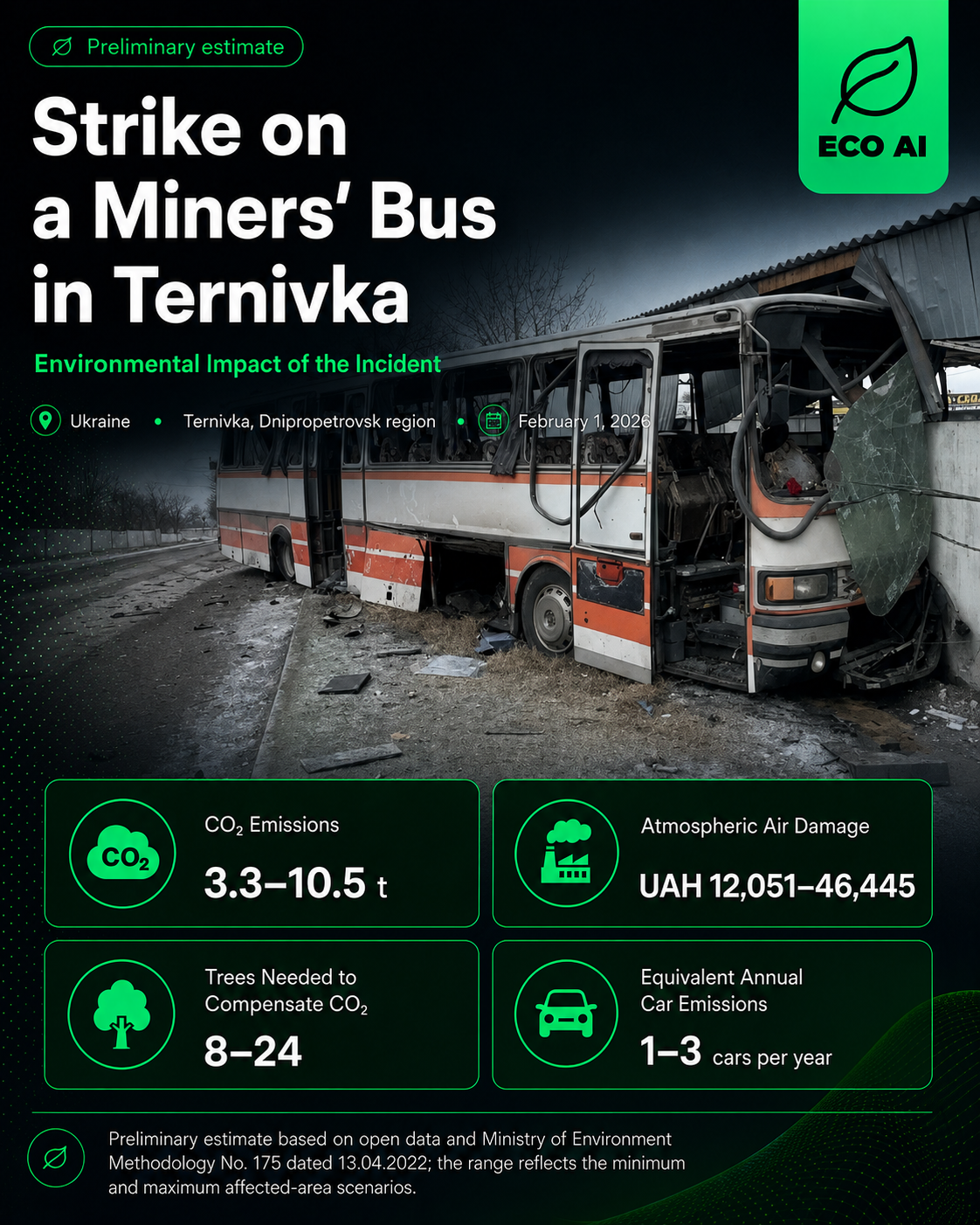
On the afternoon of 1 February 2026, Russian drones attacked a road near a company bus in Ternivka, Pavlohrad district, Dnipropetrovsk Oblast. The bus was carrying mine workers returning home after their shift. Police reported that the vehicle burned, while the UN Human Rights Monitoring Mission confirmed that several drones struck the area over a period of several minutes. According to local authorities, 12 civilians were killed and 16 were injured.
The environmental footprint is associated with the explosions, fire, and destruction of the vehicle. Emergency responders extinguished the fire, while materials from the scene confirm damage to the bus and the adjacent road area. Potential emissions may have included CO₂, smoke, soot, ash, fine particulate matter, and products of incomplete combustion.
Materials that may have burned include diesel fuel, motor oils, rubber, interior plastics, cable insulation, paints and coatings, and battery-system components. Damage to the fuel system and technical equipment also creates a risk of local leakage of fuel, lubricants, coolant, or electrolyte.
The scenario assessment uses an estimated vehicle area of 30–60 m² and a burned area of 20–45 m². Open sources do not provide official figures for the exact fire area, burning duration, or mass of materials consumed. The assessment therefore applies a scenario for an unknown duration or a fire lasting up to 12 hours.
The tree figure relates exclusively to the notional compensation of CO₂ emissions, assuming planting and maintenance for at least 10 years. Trees do not remove soot, fuel, lubricants, electrolytes, contaminated firefighting water, or hazardous waste.
Browse all preliminary environmental damage assessments published by ECO AI.