Home/ Reports/ Maternity Hospital Strike, Zaporizhzhia

Strike on a Maternity Hospital in Zaporizhzhia: Environmental Impact of the Damage
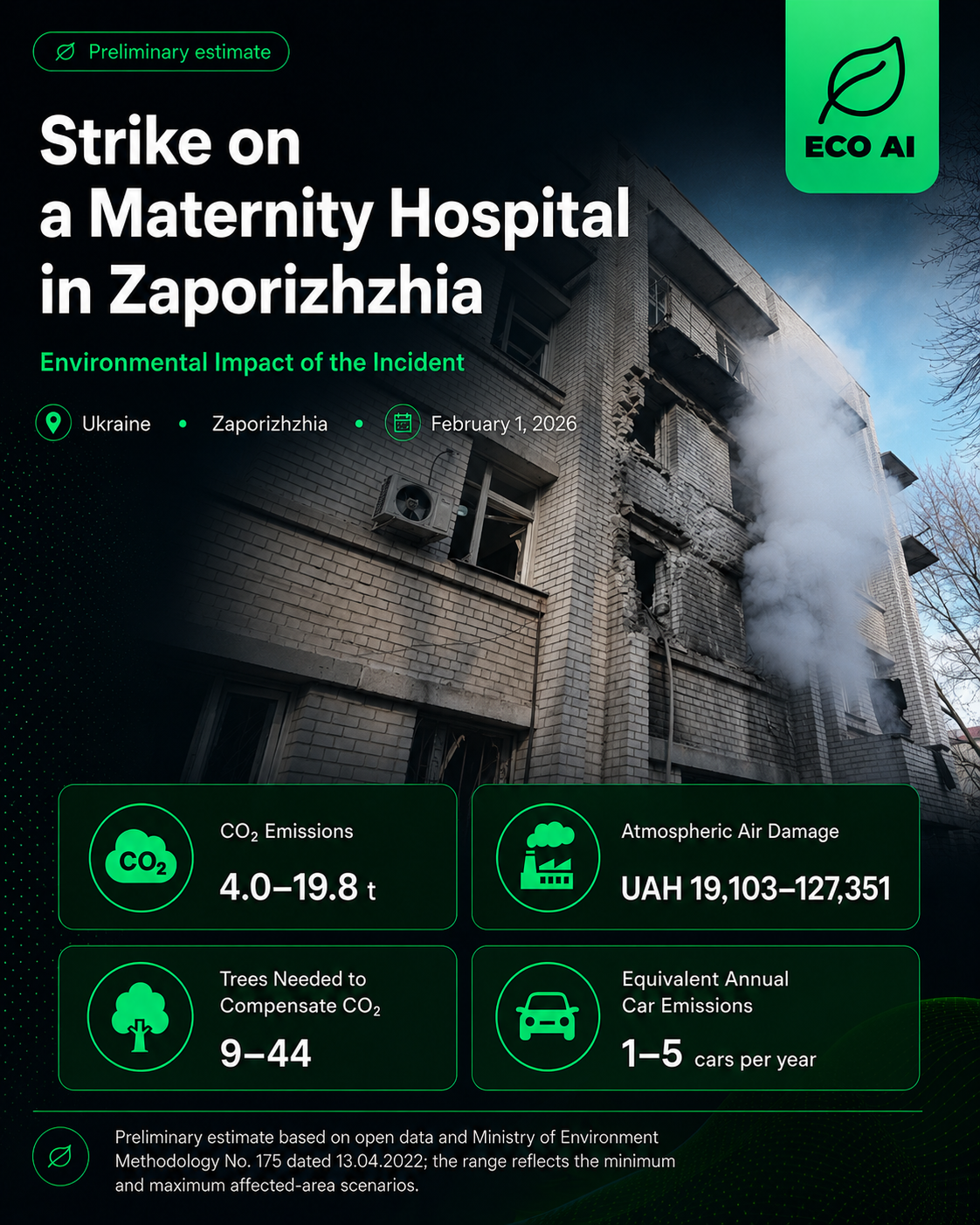
📍 Zaporizhzhia 📅 February 1, 2026 🏥 Healthcare Facility Preliminary estimate
Strike on a Maternity Hospital in Zaporizhzhia — Environmental Impact, ECO AI
💨
CO₂ Emissions
4.0–19.8 tonnes
🏭
Atmospheric Air Damage
19,103–127,351 UAH
🌳
Trees to Compensate CO₂
9–44 trees
🚗
Equivalent Annual Car Emissions
1–5 cars/year

What Happened

On 1 February 2026, during the daytime, a Russian attack damaged a maternity hospital in Zaporizhzhia. According to open-source reports and visual materials, the strike caused damage to rooms and glazing and resulted in a local fire. The main building and adjacent elements of the medical infrastructure near the impact point were affected.

🏥 Healthcare Facility Note: A further environmental concern is the possible formation of mixed construction and medical waste containing broken glass, damaged equipment, polymers, and potentially contaminated materials. Its actual composition can only be determined through an inventory and laboratory testing.

Preliminary Environmental Assessment

Analysis

The scenario calculation uses an estimated object area of 2,500–7,000 m² and a possible burned area of 50–250 m². The exact duration of the fire was not established in open sources, so coefficients for an unknown duration or a fire lasting up to 12 hours were applied. The lower bound reflects the minimum damage and burning scenario, while the upper bound represents an expanded scenario within the same object.

The explosion and structural damage may have released construction dust and fine particles into the air and generated glass fragments, finishing materials, and potentially contaminated waste. If furniture, wood, polymer-based finishes, cable insulation, medical equipment, and packaging burned, the emissions may have included smoke, soot, ash, CO₂, and products of incomplete combustion.

The tree estimate relates exclusively to compensation for the CO₂ footprint, assuming planting and maintenance for at least 10 years. Trees do not neutralise soot, dust, heavy metals, plastics, hazardous medical waste, or contamination of soil and water.

Methodology: The assessment is based on open-source information and Ukraine's Ministry of Environmental Protection Methodology No. 175 of 13 April 2022, registered by the Ministry of Justice of Ukraine on 16 April 2022 under No. 433/37769. Methodology No. 175 establishes the approach for calculating unorganised emissions and atmospheric-air damage during emergencies and martial law. The range reflects minimum and maximum scenarios for the affected area.
Disclaimer: This is a preliminary assessment based on open-source information. The stated range represents minimum and maximum scenarios and is not an official calculation by state authorities. The assessment confidence is low to medium. A more accurate estimate requires official data on the fire area and duration, the composition and mass of burned materials, the exact boundaries of the damage, emergency-service records, and laboratory measurements.
ECO AI

More Damage Reports

Browse all preliminary environmental damage assessments published by ECO AI.

📊 All Reports ← Back to Home