Home/ Reports/ Five-Storey Building Strike, Kharkiv

Strike on a Five-Storey Apartment Building in Kharkiv: Fire and Environmental Impact
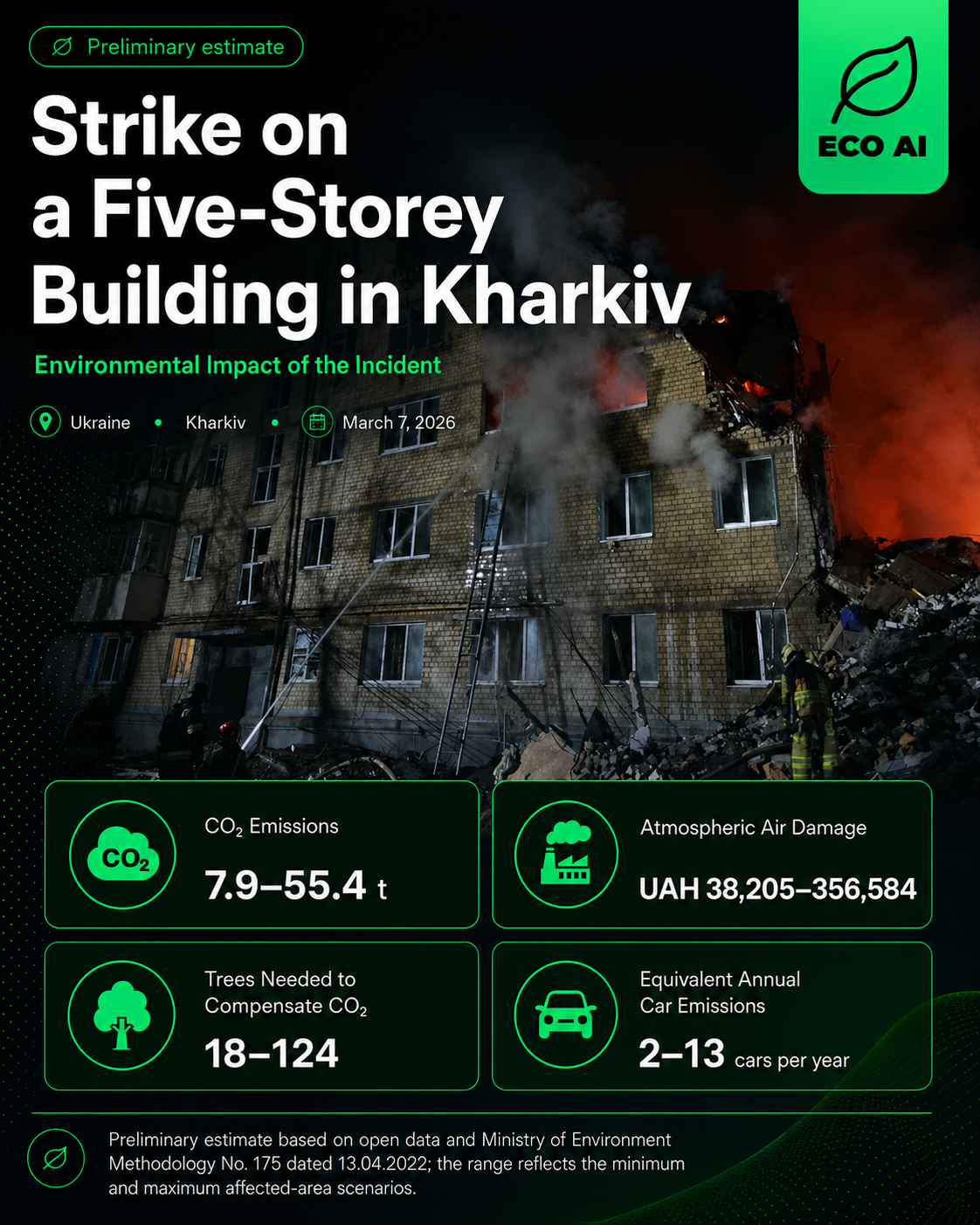
📍 Kyivskyi District, Kharkiv 📅 March 7, 2026 🏢 Residential Building Preliminary estimate
Strike on a Five-Storey Apartment Building in Kharkiv — Environmental Impact, ECO AI
💨
CO₂ Emissions
7.9–55.4 tonnes
🏭
Atmospheric Air Damage
38,205–356,584 UAH
🌳
Trees to Compensate CO₂
18–124 trees
🚗
Equivalent Annual Car Emissions
2–13 cars/year

What Happened

On the night of 6–7 March 2026, a ballistic missile struck a five-storey residential building in the Kyivskyi district of Kharkiv. One entrance section was effectively destroyed, while two floors of a neighbouring building, other residential structures, vehicles, and an educational facility were also damaged. A fire covering approximately 300 m² broke out at the site.

Preliminary Environmental Assessment

Analysis

The environmental footprint is associated with both the fire and the extensive mechanical destruction of the building. The combustion of residential materials may have released CO₂, smoke, soot, ash, fine particulate matter, and products of incomplete combustion.

Materials potentially affected by the fire include furniture, wood, textiles, plastics, cable insulation, paints and coatings, household appliances, thermal insulation, and interior finishing materials. Their precise composition and mass have not been published, which is why the estimate is presented as a range.

The scenario assessment uses an estimated object area of 2,500–6,000 m² and a possible fire-affected area of 100–700 m². The confirmed fire area of 300 m² falls within this range. The lower value represents a limited scenario involving the primary building, while the upper value reflects an expanded scenario that includes damage to adjacent structures.

🏗️ Demolition Waste Note: Search-and-rescue operations continued for more than two days. More than 2,400 m³ of construction materials were removed while the destroyed entrance section was dismantled. This waste may include concrete, bricks, metal, glass, plaster, wood, insulation, plastics, and damaged household equipment. Construction dust, soot-contaminated debris, firefighting runoff, and the soil surrounding the building require particular attention. Potentially hazardous fractions should be separated from ordinary inert demolition waste and transferred for specialised treatment.

The tree figure represents only notional compensation for calculated CO₂ emissions, assuming planting and maintenance for at least 10 years. Trees do not remove soot, ash, construction dust, plastics, contaminated firefighting water, or hazardous waste.

Methodology: The assessment is based on open-source information and Ukraine's Ministry of Environmental Protection Methodology No. 175 of 13 April 2022, registered by the Ministry of Justice of Ukraine on 16 April 2022 under No. 433/37769. Methodology No. 175 establishes the approach for calculating unorganised emissions and atmospheric-air damage during emergencies and martial law. The range reflects minimum and maximum scenarios for the affected area.
Disclaimer: The assessment is preliminary and based on open-source information. The range reflects minimum and maximum affected-area scenarios; refinement requires data on fire duration and the composition and mass of materials consumed. The figures are not an official calculation by state authorities.
ECO AI

More Damage Reports

Browse all preliminary environmental damage assessments published by ECO AI.

📊 All Reports ← Back to Home