Residential Infrastructure · War Damage · Preliminary Estimate
Strike on an Apartment Building in Dnipro: Environmental Footprint of a Destroyed Entrance
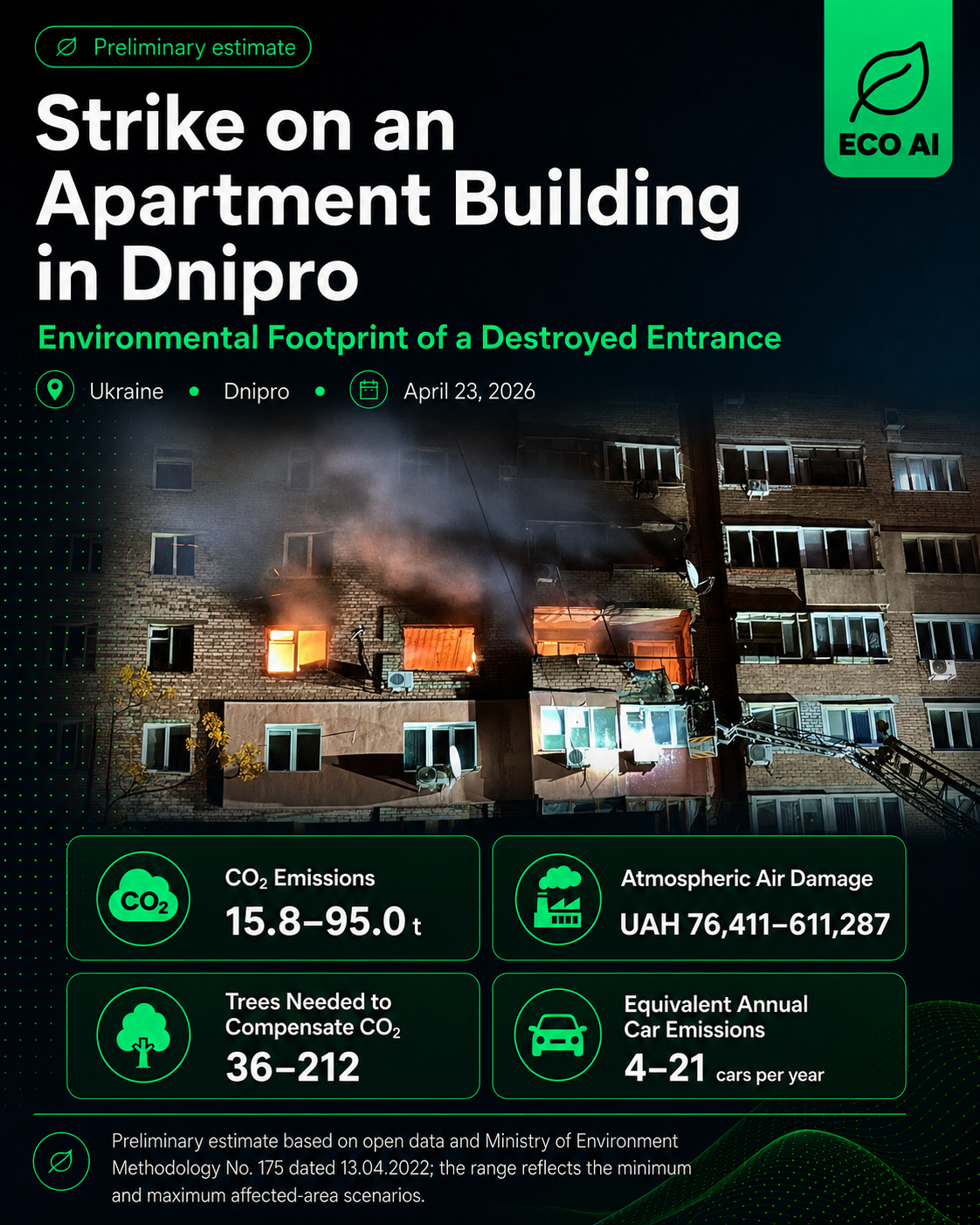
On the night of 22–23 April 2026, Russian forces launched a large-scale drone attack on Dnipro. One of the drones struck a multi-storey residential building, damaging part of an entrance section and setting several apartments on fire. Apartments on several upper floors were destroyed. Nearby residential buildings, vehicles, the courtyard area, and utility infrastructure were also reported damaged.
The environmental footprint is associated with both the combustion of residential materials and the extensive mechanical destruction of the building. The fire may have released CO₂, smoke, soot, ash, fine particulate matter, and products of incomplete combustion.
Potentially burned materials include wooden furniture, textiles, plastics, cable insulation, interior finishes, thermal insulation, household appliances, paints, coatings, and other household contents. Local authorities, police, and media confirmed fires in several apartments, although the precise burned area and duration were not officially published.
The scenario assessment uses an estimated total building area of 5,000–12,000 m² and a possible fire-affected area of 200–1,200 m². The fire duration is modelled as lasting up to 12 hours. The lower boundary represents localised burning in several apartments, while the upper boundary reflects a wider impact across the damaged entrance section.
The tree figure represents only notional compensation for the calculated CO₂ emissions, assuming planting and maintenance for at least 10 years. Trees do not remove soot, construction dust, plastics, technical fluids, contaminated firefighting water, or hazardous waste.
Browse all preliminary environmental damage assessments published by ECO AI.