Transport Infrastructure · War Damage · Preliminary Estimate
Drone Strike on a Passenger Train in Kharkiv Region: Environmental Impact
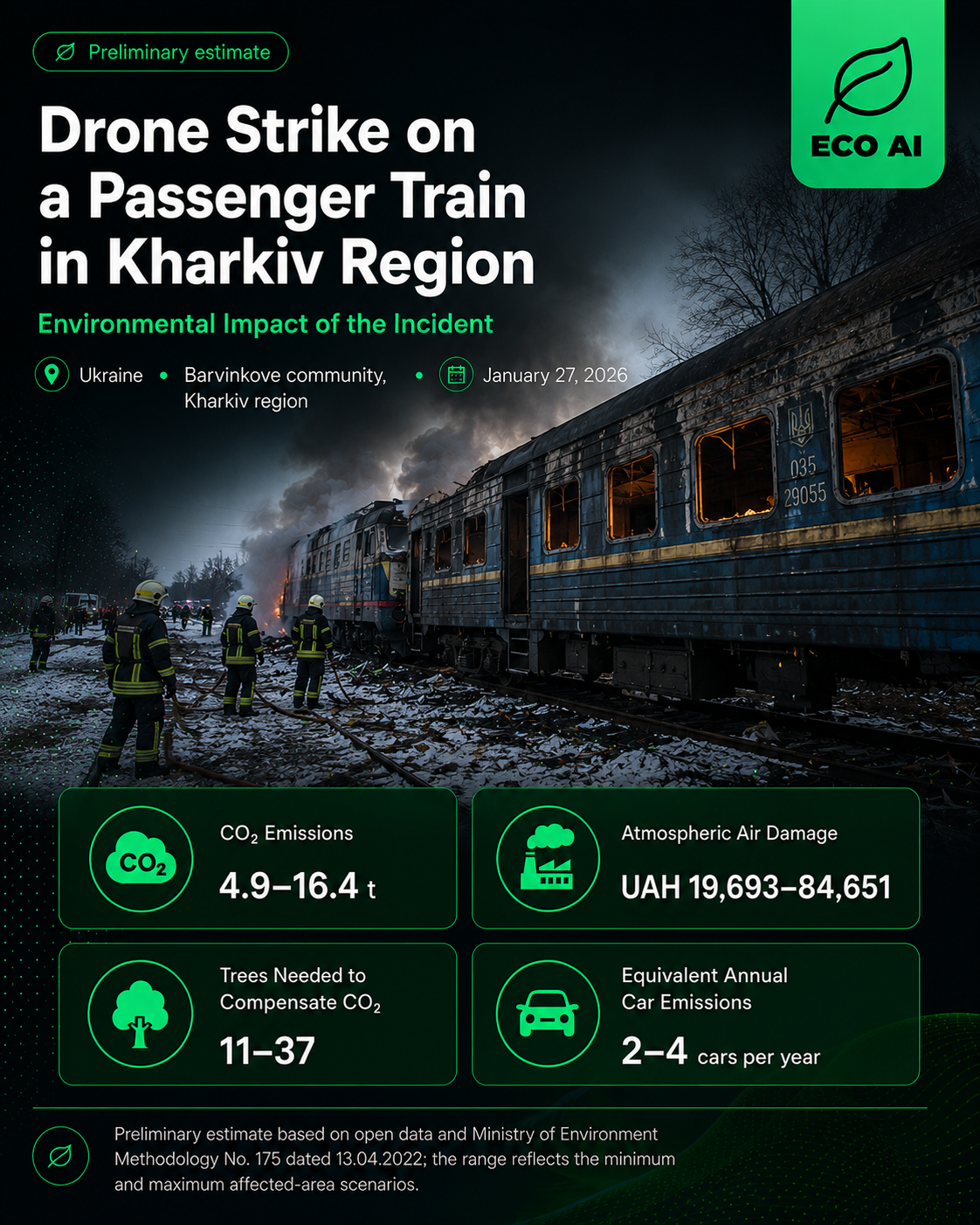
On 27 January 2026, at approximately 4:30 p.m., Russian drones attacked a passenger train in the Barvinkove community of Kharkiv Oblast. The train was operating on a route connecting Barvinkove, Lviv, and Chop. According to open-source reports, one of three attack drones struck the rolling stock, while two others hit the area near the railway line. A passenger carriage and the locomotive caught fire after the attack.
The environmental footprint is associated with the fire in the railway carriage and locomotive, damage to technical equipment, and possible contamination of the railway bed. Published images show damaged carriages beside the snow-covered tracks, while official reports confirm that parts of the rolling stock caught fire.
The combustion may have released CO₂, smoke, soot, ash, and products of incomplete burning. Potential sources include polymer-based interior materials, cable insulation, rubber, paints and coatings, textiles, lubricants, and other technical fluids. Damage to electrical and mechanical equipment may also have caused local leaks of oil, coolant, or battery electrolyte.
The tree figure represents only notional compensation for CO₂ emissions, assuming planting and maintenance for at least 10 years. Trees do not remove soot, technical fluids, contaminated ballast, hazardous waste, or possible soil and water pollution.
Browse all preliminary environmental damage assessments published by ECO AI.